
Nvidia GeForce RTX 5000: A Comprehensive Guide to the Next-Gen Gaming GPUs
The Nvidia GeForce RTX 5000 series redefines gaming with unparalleled performance and cutting-edge technology. Built on the advanced Ada Lovelace architecture, these GPUs offer exceptional ray tracing and AI-powered DLSS 4.0 for hyper-realistic graphics and smoother gameplay. With up to 24GB GDDR7 memory, gamers can experience ultra-high resolutions, faster frame rates, and seamless multitasking.
The RTX 5000 series supports PCIe Gen 5, ensuring lightning-fast data transfer and compatibility with the latest motherboards. NVIDIA Reflex and Broadcast technologies deliver reduced latency for esports enthusiasts and enhanced streaming experiences.
Whether you're a hardcore gamer or a content creator, the RTX 5000 is designed to handle demanding 4K gaming and real-time 3D rendering effortlessly. Its energy-efficient design also ensures optimal cooling and quieter operation.
Nvidia GeForce RTX 5000 GPU range
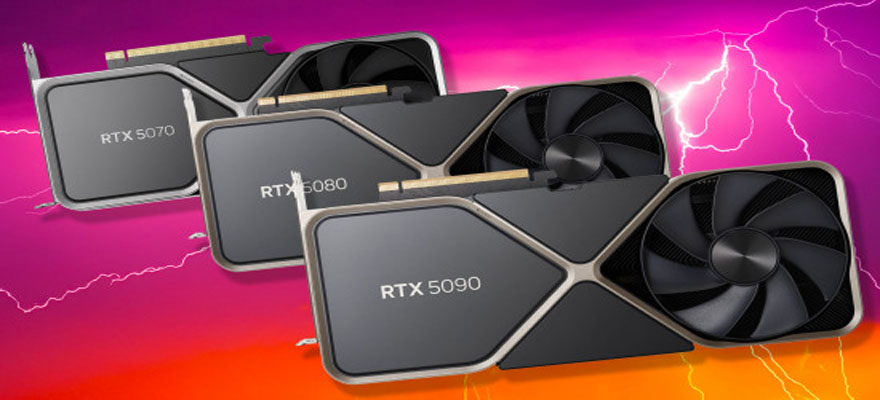
We anticipate that the first generation of Nvidia GeForce RTX 5000 graphics cards will include the high-end RTX 5090 and 5080, the mid-range RTX 5070, and the lower-end RTX 5060.
Nvidia GeForce RTX 5090
The RTX 5090 appears to be the top model in Nvidia's new Blackwell series. According to speculations, the new GPU will have a huge 32GB of GDDR7 VRAM and be built on the new GB202-300-A1 processor. It has been announced that 22 of the RTX 5090's SMs would be turned off. This would indicate that, if Nvidia maintains its conventional building block architecture, the RTX 5090 has 21,760 CUDA cores, 170 SMs, and 170 matching RT cores.
The RTX 5090 VRAM will also be connected to a 512-bit memory interface, which means it will have access to a vast amount of memory bandwidth if the leaks are accurate. It is also anticipated that the RTX 5090 power usage will peak at 600W.
Nvidia GeForce RTX 5080
According to the reports, the RTX 5080, the second Blackwell GPU from the front, would feature a much lower specification as the 5090. The most recent leaks indicate that the RTX 5080 has 84 RT cores and 10,752 CUDA cores distributed across 84 SMs. In addition to having a 256-bit memory interface and 16GB of GDDR7 memory, the RTX 5080 VRAM arrangement is said to operate at a very high clock speed of 32Gbps, which might result in a total memory bandwidth of 1,024GB/s, which is even more than the RTX 4090.
Additionally, there are reports that a 24GB RTX 5080, which will supposedly have more memory but the same core GPU specs as the 16GB card, will be released later. Using 3GB DRAM chips instead of 2GB ones, like the recently released Samsung 24Gb GDDR7 DRAM, would make this feasible.
GeForce RTX 5070 from Nvidia
The most recent reports indicate that the RTX 5070, which is based on the new GB205 GPU, has up to 6,400 CUDA cores and 50 RT cores. Nevertheless, it is also said to have a tight 192-bit interface with 12GB of VRAM, similar to the current RTX 4070. However, the memory should still have a respectable amount of bandwidth available because it is at least supposed to be GDDR7.
GeForce RTX 5060 from Nvidia
The RTX 5060 is anticipated to come soon after the RTX 5070 and will be the most reasonably priced desktop GPU in the new Blackwell series. Although there haven't been many leaks on the specifications yet, we're hoping that this GPU will address some of the issues with the RTX 4060, its predecessor, such its low bandwidth and unexpectedly high cost.
Estimated Release Date for Nvidia GeForce RTX 5000 Series
Nvidia has officially announced its GeForce RTX 50-series graphics cards, including the RTX 5090, RTX 5080, RTX 5070 Ti, and RTX 5070, during CES 2025.
The RTX 5090 and RTX 5080 are scheduled for release on January 30, 2025, with the RTX 5070 Ti and RTX 5070 following in February. These GPUs feature the new Blackwell architecture, GDDR7 memory, and DLSS 4 technology, offering significant performance improvements over previous generations.
Upgrade to the Nvidia GeForce RTX 5000 series for the ultimate gaming experience in 2025. Experience gaming like never before!


